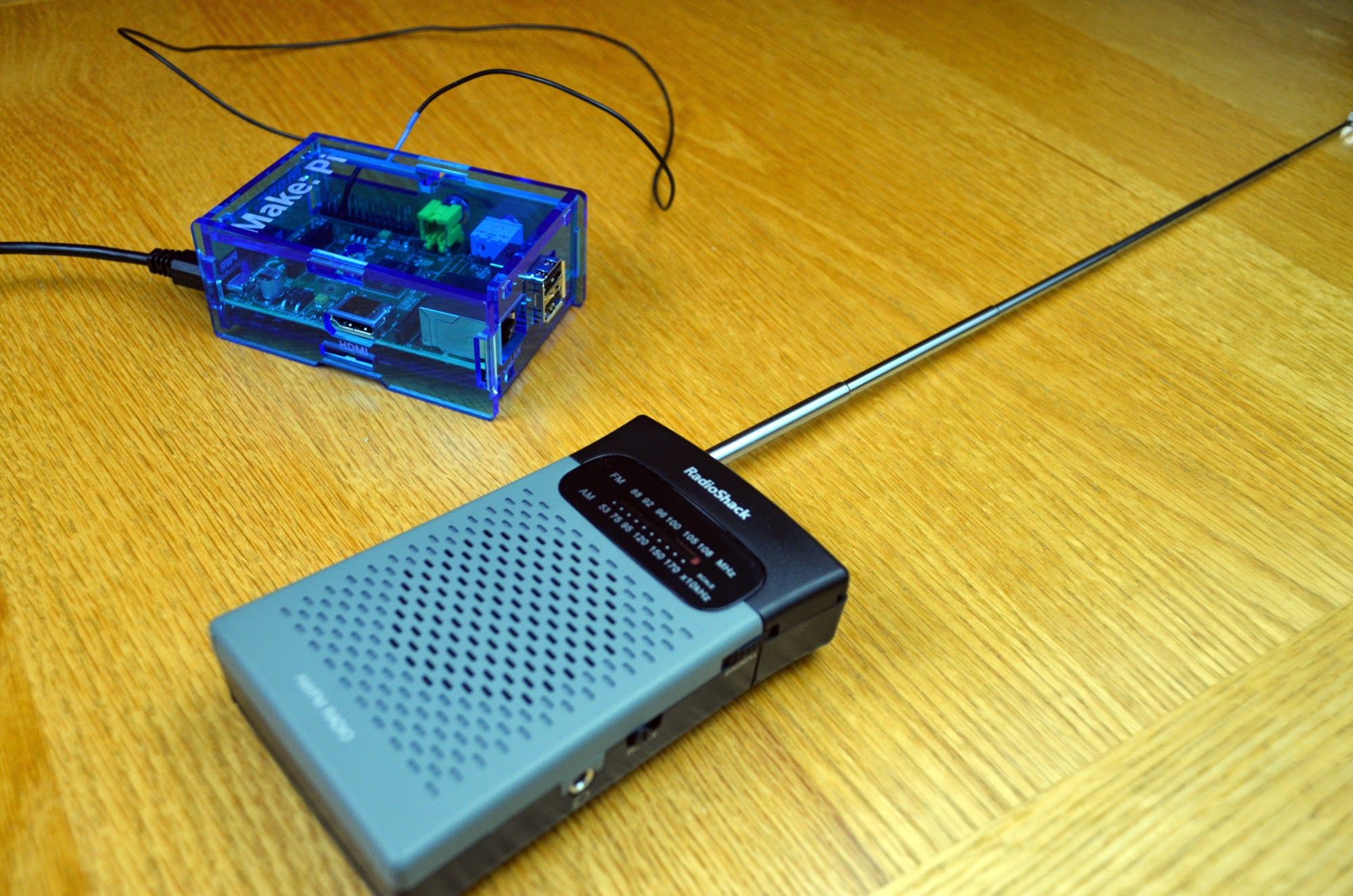
It’s DIY Music week at #MakerCamp and on Friday we’ll take a look at the Raspberry Pirate Radio. With just one wire and some open-source code, easily modify a Raspberry Pi into a FM radio transmitter! Check it out: http://m8k.me/1lbQZgs and join us at all week at http://makercamp.com/ !
1. The Prophets and Promise of Classical Capitalism
2. The Manners and Morals of High Capitalism
3. The Dissent of Karl Marx
4. The Colonial Idea
5. Lenin and the Great Ungluing
6. The Rise and Fall of Money
7. The Mandarin Revolution
8. The Fatal Competition
9. The Big Corporation
10. Land and People
11. The Metropolis
12. Democracy, Leadership, Commitment
13. Weekend in Vermont (three one hour programmes in which Galbraith discusses economics, politics and international relations with guests such as Henry Kissinger, Georgy Arbatov and Edward Heath). These interviews are not covered in the book.
Milton Friedman’s Free to Choose was in part a response to and rebuttal of Galbraith’s series.
Can we have distributed communications systems or not? A conversation on Diaspora has gone so wrong, that I suspect impersonation. Edward Morbius continues to tell me that port blocks and other technical measures against people running mail servers are justified by the high volume of spam that large mail ops receive. I think that leads to unacceptable spying and censorship and that the same reasoning will be used to dismantle any effective, distributed communications method. If I can’t be trusted to run a mail server, why should I be trusted to run a Friendica pod? Is this really Ed that I’m talking to?
If anything the cost of spam to large providers proves that email and other services are better done small. Small servers don’t have enough readers to be worth while. Damage to one server impacts fewer people. An abundance of choices gives everyone redundancy, and so on and so forth. There is an analogous security argument for an abundance of free software distributions. Freedom leads to cooperation, abundance, diversity and security. Centralization leads to monopoly, censorship and neutralization of dissidence. I thought these were bedrock concepts of free computing and networking.
The Morse Code Virtual Radio is our new educational resource that lets you simulate the main form of radio communication that was used during World War I, using your Raspberry Pi.
You’ll learn how to send and decode Morse Code messages, and gain experience in Python programming and using the Raspberry Pi GPIO pins.
It starts out intense… and then keeps getting more so.
You can control the shape of the little rectangles by moving your cursor over the screen. Try to keep your eye on just one little rectangle! It moves up and down, not very fast… but sometimes it’s impossible to keep your eye on it, because all the rectangles together produce patterns that grab your WW1 #morsecode#python#gpioattention. These are called moiré patterns.
I think the ‘hypersnake’ here is attention-grabbing because your brain has parts that are good at detecting snakes, even before your brain conscious of it. Your amygdala is one of these parts:
Information from an external stimulus reaches the amygdala in two different ways: by a short, fast, but imprecise route, directly from the thalamus; and by a long, slow, but precise route, by way of the cortex.
It is the short, more direct route that lets us start preparing for a potential danger before we even know exactly what it is. In some situations, these precious fractions of a second can mean the difference between life and WW1 #morsecode#python#gpiodeath.
Here is an example. Suppose you are walking through a forest when you suddenly see a long, narrow shape coiled up at your feet. This snake-like shape very quickly, via the short route, sets in motion the physiological reactions of fear that are so useful for mobilizing you to face the danger. But this same visual stimulus, after passing through the thalamus, will also be relayed to your cortex. A few fractions of a second later, the cortex, thanks to its discriminatory faculty, will realize that the shape you thought was a snake was really just a discarded piece of garden hose. Your heart will then stop racing, and you will just have had a moment’s scare.
The ‘moiré eel’ was made by Darius Bacon. You can see more of his stuff here: